
Mar 6, 2025
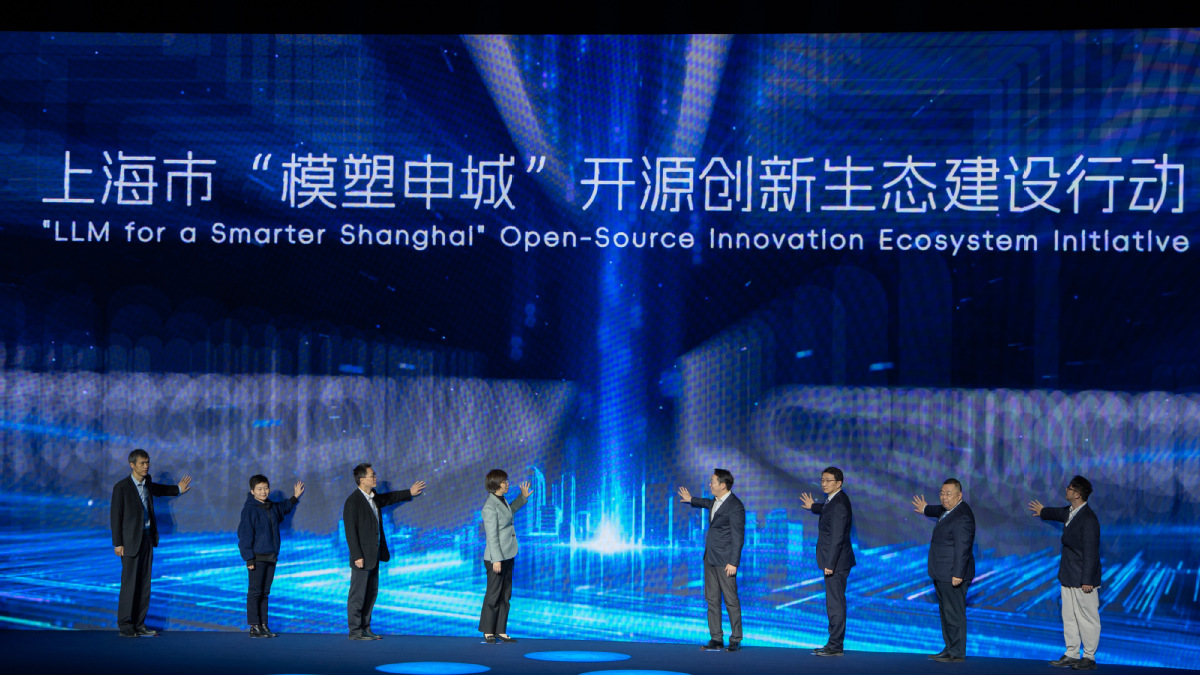
Last month I had the privilege of attending the Global Developer Conference (GDC) in Shanghai, where I delivered a keynote, a short lecture, and participated in the inaugural Linux Foundation Asia Open Source User Group meeting. This energy-filled event was attended by 50k people including government leaders, researchers, entrepreneurs, developers, enterprise executives, and even families with young children.
I’d like to thank the Shanghai AI Industry Association for their kind invitation and for being such incredibly generous and thoughtful hosts. I am also grateful to the Linux Foundation APAC team for their support. The event showcased China’s unified approach to AI, emphasizing open source, academic research, startup ecosystems, and enterprise and consumer adoption. Below are some key takeaways:
Me — looking slightly too serious
AI Momentum in China, and Shanghai Specifically
China’s AI market momentum was palpable, which is unsurprising since Shanghai alone surpassed $62 billion in 2024. This rapid growth has been driven by a cohesive strategy spanning government investment, academic research, enterprise adoption, and public engagement. The city’s vision of building a world-class AI industrial cluster was evident in every session, exhibit, and discussion. Government policies are not just supportive but strategically designed to integrate AI across sectors, from enterprise applications to consumer technology. This unified approach is a powerful model for how AI can be developed and adopted at scale.
Shanghai AI Village
The Ubiquity of ‘Open Source’
Open source was a recurring theme throughout the conference, mentioned over 100 times during the opening keynotes. However, I noticed a significant omission: While the term was frequently used, no definition was mentioned by the other presenters. This prompted me to clarify in my keynote that open source is not merely about code accessibility or a license. It must reflect a set of behaviors embodying a philosophy of collaboration, transparency, and shared ownership — principles that are essential for democratizing AI and fostering sustainable innovation.
Diverse Audience Engagement
The exposition hall was a testament to AI’s broad appeal in China, drawing in developers, consumers, and even families. One particularly striking example was a booth teaching children as young as five to develop their own large language models (LLMs). This early engagement in AI and coding is not just about education; it reflects a broader strategy to embed AI literacy across all levels of society, ensuring a pipeline of future talent for China’s AI ecosystem.
Government and Academic Support
The alignment between government initiatives and academic research in China was both impressive and instructive. China’s position as a significant and vocal contributor to open-source projects clearly indicates this support. Models like DeepSeek-R1 were highlighted as examples of how open-source principles accelerate AI innovation. The message was clear: Open source is not just a tool for transparency, but a strategic advantage for AI leadership.
Shanghai — The LLM Building
Key Observations
- Unified AI Strategy: China’s approach to AI is a model of strategic alignment between government policy, big tech, academic research, investors and startups, and enterprise adopters. The result: A robust and rapidly growing AI ecosystem.
- Open-source Adoption: The frequent mention of open source underscores its importance. However, the lack of agreement and understanding of what open source means will remain a barrier to effective collaboration.
- Broad Interest in AI: The diverse audience, from developers to families, highlights the effectiveness of China’s strategy to integrate AI into everyday life.
- Government’s Strategic Role: The Chinese government’s active support accelerates AI’s growth and adoption.
Conclusion
The 2025 Global Developer Conference was a powerful reminder of the transformative potential of AI and open source — particularly when supported by a unified strategy across government, academia, and industry. As we move forward, a clear understanding of open source and a holistic approach to AI adoption will be essential in shaping an inclusive and sustainable AI ecosystem.