
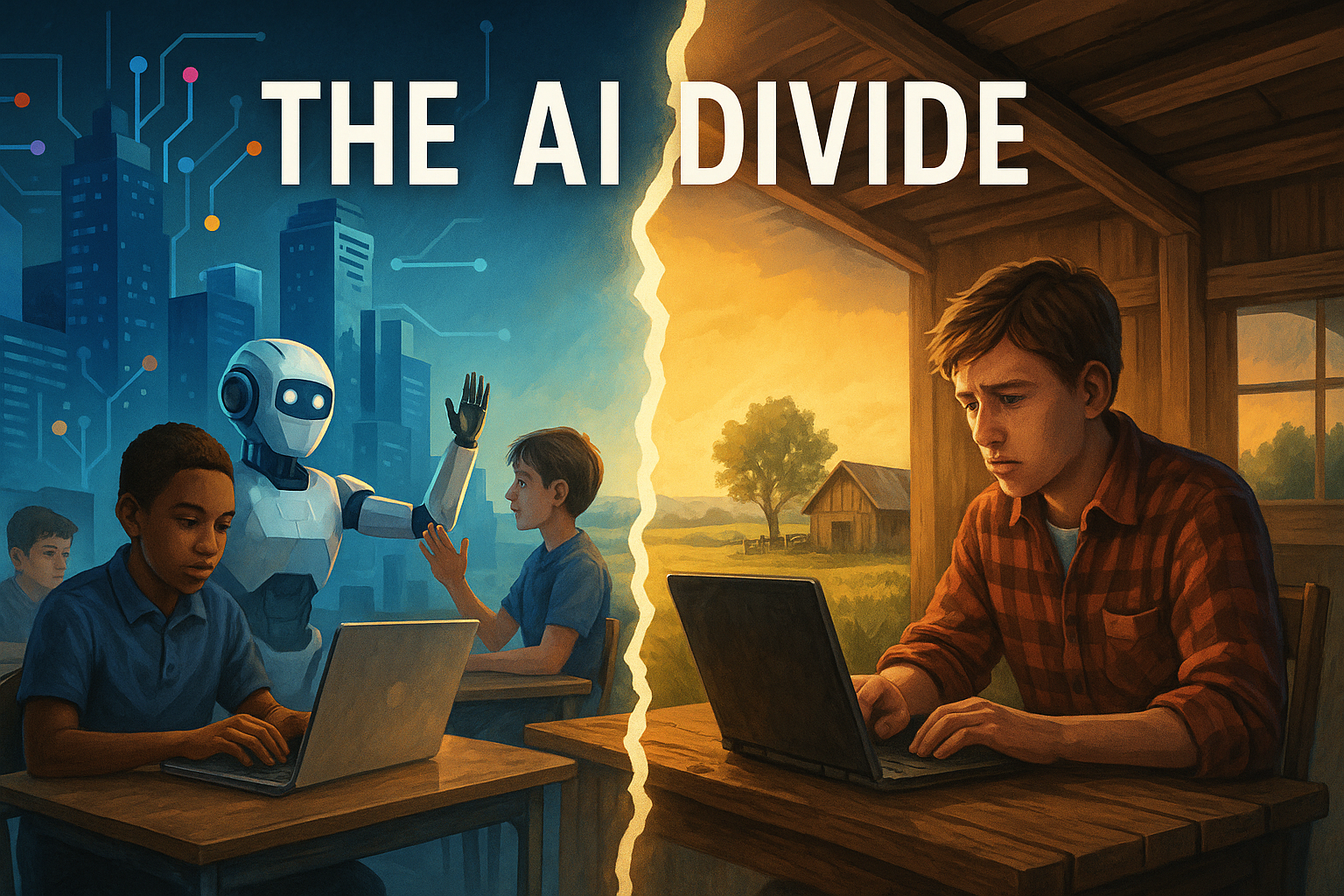
In some American schools, kindergartners learn how to give mini-TED talks, while middle schoolers compete in sophisticated VEX AI Robotics Championships using “hands-on, industry-standard tools to design, build, and compete against teams with the most advanced aerial robotics technology available.” Meanwhile, across rural America, the reality is starkly different. Students and educators in rural and economically disadvantaged areas continue to struggle with bridging the digital divide; even in many high school districts, students lack access to their own devices.
This contrast—between schools where young children master advanced presentation skills and compete with cutting-edge AI robotics, while others struggle to maintain basic internet connectivity—captures what researchers are increasingly calling the “AI divide.”
A Different Challenge Than Before
AI represents a fundamentally different challenge than past rural technology gaps. While rural communities historically lagged in adopting electricity, telephone service, and internet access, AI demands something unprecedented: continuous connectivity, real-time data processing, and constant updates. Past technologies, such as telephones, took decades to reach 50% adoption, but modern innovations are adopted in five years or less. AI doesn’t just require infrastructure—it needs infrastructure that never fails. A dropped call was inconvenient; a failed AI diagnostic tool could be life-threatening.
Unlike previous technologies that could work in isolation, AI systems are inherently networked, requiring integration with cloud services, data centers, and constantly evolving models. This creates a moving target that rural communities must hit while technology accelerates at an unprecedented pace.
The Scale of What’s at Stake
Approximately 17 percent of the U.S. population resides in rural counties, comprising roughly 60 million people. While the share of rural counties’ national GDP fell to 7.8 percent in 2023, they remain economically vital. Agriculture, food, and related industries contributed 5.5 percent to U.S. GDP and provided 10.4 percent of employment.
Globally, the stakes are even higher. Agriculture can help reduce poverty, raise incomes, and improve food security for approximately 80% of the world’s poor, who reside in rural areas and primarily work in farming. In developing nations, agriculture accounts for 29% of GDP and 65% of jobs. This isn’t a niche market—it’s billions of people whose livelihoods depend on systems AI is increasingly supposed to optimize.
Yet rural America faces challenges that urban-based AI tools rarely account for. Broadband is unreliable or unaffordable. Many schools and clinics lack full-time tech staff. Teachers and nurses already wear multiple hats, with little time or training for complex new systems.
And the AI itself? Most wasn’t built for them.
Recent studies confirm this pattern. A 2025 review of U.S. healthcare AI research found that while dozens of predictive models are being developed, almost none have been tested or deployed in rural settings. Another analysis showed that telehealth use still lags in rural regions due to poor internet connectivity and low familiarity with digital tools.
Education shows the same pattern. A 2025 study of rural school leaders found they are optimistic about AI’s potential to personalize learning, but struggle with “thin budgets, unstable broadband, and minimal training.” The U.S. Department of Education’s 2024 National Educational Technology Plan calls this the “digital access and design divide,” warning that without targeted support, rural students will fall further behind.
Even AI datasets often exclude rural realities. A 2025 paper showed poverty-mapping AI performs worse in rural areas simply because they have far less training data. Another study found speech recognition models struggled badly with rural Bhojpuri-speaking women until researchers added even small amounts of local data.
If you live in a city, AI probably “sees” you. If you live in a rural town, it often doesn’t.
When Tools Don’t Fit the Terrain
This mismatch isn’t just inconvenient—it can be harmful. An AI model trained on urban hospital data might misread rural patient symptoms or assume nonexistent lab tests. A virtual tutor built on mainstream dialects might misinterpret a rural student’s accent. A bank’s AI chatbot might be unusable to someone with patchy internet and low digital literacy.
“The promise of AI-revolutionized agriculture sounds compelling in theory, but the reality on rural farms tells a different story. With roughly 20% to 30% of rural areas lacking sufficient cellular network coverage, farmers who invest in precision agriculture technology often find themselves waiting for connectivity that never materializes. Smart tractors, automated irrigation systems, and AI-powered crop monitoring tools all depend on reliable data connections that simply don’t exist across vast stretches of American farmland.
Meanwhile, rural workers face strain. A 2024 survey of 1,000 rural workers found they face nearly three times the rate of tech access problems for education and double the broadband issues compared to urban peers.
This is the AI divide: not one dramatic collapse, but a thousand small frictions that add up to exclusion.
The Economics of Exclusion
The AI divide isn’t accidental—it’s driven by market forces making rural communities economically unattractive to tech companies.
Market Incentives Work Against Rural Areas: Tech companies optimize for scale and profit margins. Urban markets offer higher user density and faster internet, making deployment cheaper per user. The “80/20 rule” dominates: capture 80% of the market with urban/suburban solutions, worry about the rest later—if at all.
Hidden Costs Add Up: Rural markets require custom solutions for different dialects, infrastructure limitations, and local contexts that don’t scale efficiently. Support costs are higher due to lower digital literacy and diverse technical environments. Data collection is more expensive and sparse.
“Rural hospitals face unique cost barriers when implementing AI technology. Healthcare IT leaders consistently report that limited budgets and resources are the primary obstacle to AI adoption, with 35% citing this as their top concern. Rural facilities, already struggling with thin margins and limited technical staff, often find AI vendors require extensive custom integration, specialized training, and round-the-clock support that urban hospitals take for granted. Most challenges are trickier for rural facilities to navigate, and such facilities are already used to being left behind
Economic Consequences Compound: Rural communities miss opportunities from precision agriculture and telemedicine efficiency gains. Brain drain accelerates as young people move to cities for AI-enhanced opportunities. Productivity gaps widen, further concentrating economic activity in urban areas.
“My daughter wants to study computer science, but she says there’s no point staying here where the internet barely works,” notes Jennifer Walsh, a Kentucky school board member. “We’re losing our best kids to places where AI actually functions.”
Signs of Hope: Co-Design and Local Solutions
It doesn’t have to be this way—and there are glimmers of change.
In Arizona and Texas, the RAISE AI Collaborative launched in 2025 to co-design AI education programs with rural school districts. Instead of dropping in prebuilt software, they sit down with local teachers, parents, and students to determine what’s useful, culturally relevant, and realistic to maintain.
Similar efforts are starting in rural healthcare: AI-powered mobile clinics, new broadband funding for remote hospitals, and local data cooperatives helping small communities own and shape their health data.
These projects work because they start with the community, not the technology.
What Needs to Change
If AI is going to help rural communities instead of deepening divides, it must change in key ways. From my perspective as a strategist advising the Fort Lewis College AI Institute, here are practical, incremental steps that could help begin bridging this gap:
1. Infrastructure First (Lay the Groundwork)
- Start small with shared-access solutions: Pilot shared device libraries or mobile device carts in partner rural schools to help students and teachers get consistent access without requiring full 1:1 deployments right away.
- Leverage existing networks: Explore partnerships with local internet service providers or co-ops to extend reliable broadband coverage to a handful of pilot classrooms or clinics as demonstration sites.
2. Local Validation (Test in the Real World)
- Prototype before scaling: Run micro-pilots of AI tools—such as tutoring platforms or agriculture decision aids—in rural schools or farms nearby. Gather feedback on usability, connectivity challenges, and cultural fit before expanding.
- Document the friction: Build a simple playbook capturing what fails in rural contexts (e.g., offline modes, lack of training, bandwidth limits) so future deployments are informed by local realities.
3. Community Voice (Involve Local Stakeholders Early)
- Create a Rural Advisory Circle: Convene a small group of local educators, healthcare workers, farmers, and students to provide ongoing feedback on AI initiatives.
- Host listening sessions: Organize low-stakes community roundtables to learn what people actually want from AI, and what they don’t.
4. Training & Capacity (Invest in People First)
- Offer micro-credentials: Develop short, focused AI literacy modules for teachers, clinic staff, and small business owners to build confidence and baseline understanding.
- Peer training model: Identify a few local “AI champions” and invest in their training so they can mentor others in their communities.
5. Economic Incentives (Align Market Forces)
- Seed small grants: Partner with local foundations or credit unions to create micro-grants for rural businesses or schools that want to pilot AI tools.
- Highlight success stories: Publicize early wins to attract additional partners and reduce the perceived risk of investing in rural deployments.
6. Market-Making Policies (Shape the Environment)
- Collaborative procurement pools: Consider forming small regional consortia of schools or clinics to collectively negotiate for AI tools that meet the needs of rural areas.
- Policy sandboxing: Advocate for pilot-friendly policies that allow for experimentation without heavy compliance burdens early on.
7. Ethical Guardrails (Protect Rural Communities)
- Local data stewardship: Start by drafting lightweight data-sharing agreements, ensuring that if rural communities contribute data, they retain rights to benefit from its use.
- Privacy-first pilots: Prioritize tools that allow for local/offline data processing to build trust while connectivity remains patchy.
These steps are deliberately modest and targeted—meant to lower barriers, demonstrate early wins, and build trust while larger structural challenges are gradually addressed. Over time, these efforts will create the conditions for more ambitious AI initiatives to succeed in rural communities.
Bridging the Divide
Rural communities don’t lack talent or ambition—they lack tailored tools, representation in data, and a voice in design.
The AI divide isn’t inevitable. It’s a design choice we’ve made, often by omission. And it’s one we can unmake.
By bringing rural voices into AI design, validating tools locally, investing in infrastructure and training, and creating economic incentives that make rural deployment profitable, we can ensure the AI revolution lifts all communities—not just the ones with the fastest Wi-Fi.